English
 Español
 Português


How to Spot and Avoid Crypto Scams
Crypto scams are fraud schemes that trick you into sending cryptocurrency or handing over the keys to your wallet — through fake investments, phishing sites, impersonators, rug pulls, or "guaranteed" returns. You avoid them by recognizing a few consistent red flags: promises of guaranteed profit, pressure to act fast, unsolicited messages, and anyone asking for your seed phrase.
Crypto is a genuine technology, but it's also a favorite hunting ground for fraudsters. In 2023 alone, the FBI's Internet Crime Complaint Center received more than 69,000 complaints involving cryptocurrency, with over $5.6 billion in reported losses.1 Blockchain-analytics firm Chainalysis estimates that crypto fraud brought in at least $4.6 billion that same year, and the U.S. Federal Trade Commission reports that more than 46,000 people lost over $1 billion to crypto-related fraud between January 2021 and mid-2022.2 This guide explains why crypto attracts fraud, walks through the most common crypto scams and how each one works, gives you a red-flags checklist to spot them, and shows you how to protect yourself — plus an honest look at what to do if you've already been caught.
Is crypto a scam? No — but scammers love it
Let's answer the question directly: crypto itself is not a scam. Cryptocurrencies are a real, working technology, and the same networks that criminals abuse also settle billions in legitimate transactions every day. If you're new to the basics, our guide to what cryptocurrencies are covers the fundamentals.
But three features of crypto make it unusually attractive to fraudsters:
- Transactions are irreversible. Unlike a credit-card charge-back or a disputed bank transfer, a confirmed crypto payment can't be reversed. Once your funds move, they're gone. As the U.S. Federal Trade Commission puts it, "once you pay with cryptocurrency, you can usually only get your money back if the person you paid sends it back."3
- It can be pseudonymous. Wallet addresses aren't tied to a name by default, so scammers can collect funds and disappear behind an address that's hard to trace and harder to sue.
- It runs on hype and FOMO. The stories of overnight fortunes create a fear of missing out that scammers weaponize — dangling "guaranteed" gains on the next big coin before you have time to think.
The most common crypto scams and how each one works
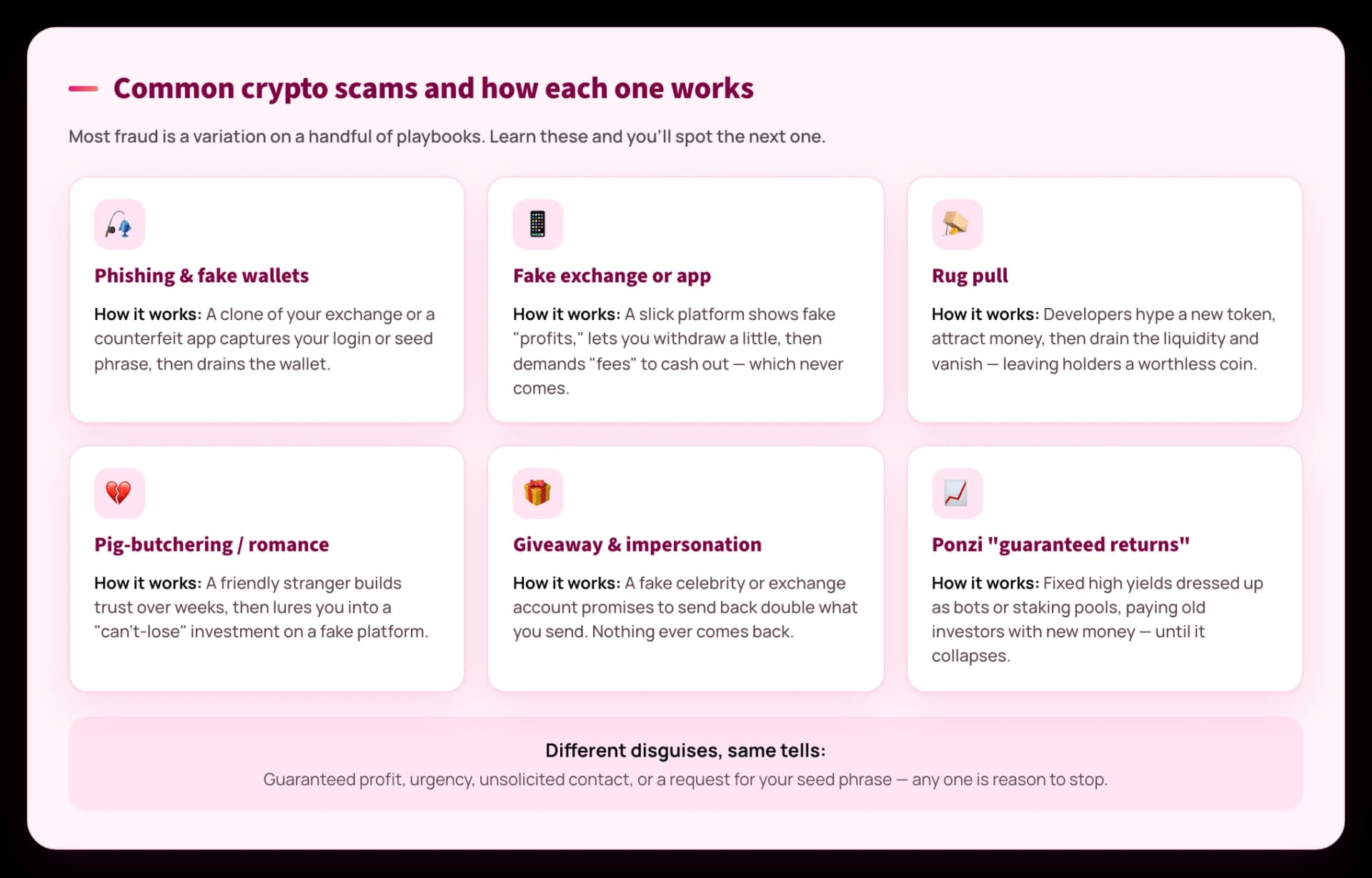
Most crypto fraud is a variation on a handful of playbooks. Learn these and you'll recognize the next one even when it wears a new disguise. The money at stake keeps climbing: FBI figures show crypto-investment fraud alone jumped from $907 million in 2021 to $2.57 billion in 2022, then to $3.9 billion in 2023.1
Phishing and fake wallet scams
Phishing is the classic. You get an email, text, or DM — or land on a search ad — that looks like your exchange or wallet provider. The link goes to a near-perfect clone of the real site. When you "log in" or "connect your wallet" and enter your seed phrase or password, you hand it straight to the attacker, who empties the wallet in seconds. Fake wallet and "wallet-drainer" apps work the same way: a counterfeit app in an app store or an ad captures your recovery phrase the moment you set it up. Security researchers at Scam Sniffer tracked more than $295 million siphoned from roughly 324,000 victims by wallet-drainer kits in 2023 — a booming underground market that sells ready-made phishing kits to would-be thieves.
Fake exchanges and trading apps
Some operations go bigger and build an entire fake platform. The site or app shows a slick dashboard, your "balance," and even rising "profits" — all fabricated numbers. You can often withdraw a small amount early to build trust, but when you try to cash out a real sum you're told to pay "taxes" or "fees" first. Every extra payment is just more money into the scammer's pocket, and the withdrawal never comes.
Rug pulls
A rug pull happens when the developers of a new token or project hype it up, attract investor money, then abandon it — draining the liquidity and vanishing, leaving holders with a worthless coin. These are common in newer, unaudited corners of decentralized finance (DeFi), where anyone can launch a token in minutes and there's no gatekeeper. The 2021 Squid Game token (SQUID) is a textbook case: it soared past $2,860 on hype, then crashed to near zero in minutes when the developers cashed out roughly $3.3 million and disappeared. A sudden, anonymous team promising huge returns on a coin you've never heard of is the classic setup.
Pig-butchering and romance scams
It usually starts with a friendly stranger — often a wrong-number text or a dating-app match — who builds a relationship over weeks or months. Eventually they introduce a "can't-lose" crypto investment on a platform they recommend (a fake exchange, see above). The victim invests more and more as fabricated profits climb, until they try to withdraw and discover it was all a script — many of these operations are run out of forced-labor compounds in Southeast Asia.
Giveaway and impersonation scams
These exploit trust in a famous name. A fake account or a hijacked livestream impersonates a celebrity, a company, or an exchange and announces a "giveaway": send 1 ETH to this address and we'll send 2 ETH back. No one ever sends anything back. The most notorious example came in July 2020, when attackers hijacked the verified Twitter accounts of Elon Musk, Barack Obama, Bill Gates, and Apple to push a doubling-your-bitcoin ruse, collecting about $118,000 in a matter of hours. Impersonators also pose as customer "support," a government agency, or even a wallet provider, urging you to "verify" your wallet by entering your seed phrase or moving funds to a "safe" address they control.
Ponzi schemes and "guaranteed returns"
Any scheme promising fixed, guaranteed high returns — often paying early investors with later investors' money — is a Ponzi scheme. In crypto they're dressed up as "arbitrage bots," "cloud mining," "staking pools," or "high-yield programs" boasting daily returns. Two of the largest show the scale: OneCoin, fronted by Ruja Ignatova (the "Cryptoqueen," now on the FBI's Ten Most Wanted list), pulled in an estimated $4 billion+ from investors across more than 175 countries for a coin that never ran on a real blockchain; BitConnect collapsed in 2018 after taking in roughly $2.4 billion, and the SEC charged its founder in 2022. Every such scheme works until new money dries up, then collapses. The tell is the promise itself: legitimate investments never guarantee profit.
Pump-and-dump
In a pump-and-dump, organizers quietly accumulate a cheap, obscure coin, then flood social media and chat groups with hype to "pump" the price. Once outsiders pile in and the price spikes, the organizers "dump" their holdings at the top, the price crashes, and everyone who bought the hype is left holding the loss.
The red-flags checklist: how to spot a crypto scam
Almost every scheme above trips at least one of these wires. The FTC found that nearly half of people who lost crypto to fraud since 2021 said it started with an ad, post, or message on a social-media platform such as Instagram, Facebook, or WhatsApp, and the median individual loss was about $2,600.2 Treat any of these signals as a reason to stop and verify:
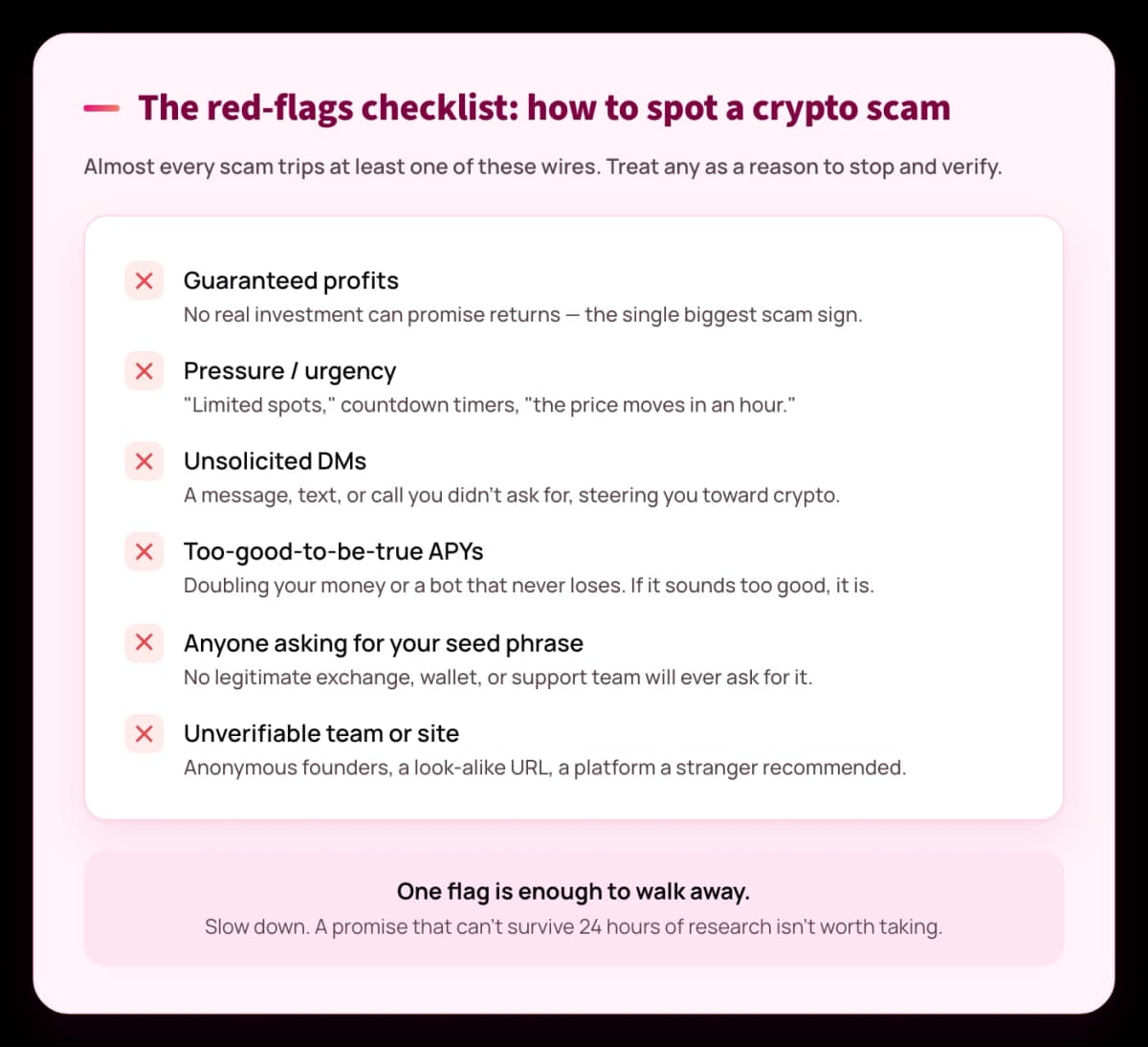
- Guaranteed or "risk-free" profits. No real investment can promise returns. This is the single biggest crypto scam sign.
- Pressure to act now. "Limited spots," countdown timers, "the price moves in an hour." Urgency exists to stop you thinking and checking.
- Unsolicited contact. A DM, text, or call you didn't ask for — a stranger, a "support agent," a new online romance — steering you toward crypto.
- Too good to be true. Doubling your money, a celebrity giveaway, a bot that never loses. If it sounds too good to be true, it is.
- Anyone asking for your seed phrase or private keys. No legitimate exchange, wallet, or support team will ever ask for your recovery phrase. A request for it is a scam, full stop.
- Requests to pay "fees" to unlock a withdrawal. Real platforms deduct fees from your balance; they don't demand a fresh payment before releasing "your" money.
- Off-platform payment. Being asked to move money to a personal wallet, a "special" app, or via gift cards and crypto to resolve a "problem."
How to protect yourself from crypto scams
Learning how to avoid crypto scams comes down to a few durable habits:
- Never share your seed phrase — with anyone, ever. Write it down offline and keep it that way. Whoever holds your recovery phrase controls your crypto. Our guide to cold wallets and storing crypto safely explains why the phrase is your money.
- Verify URLs and apps carefully. Type your exchange's address yourself or use a saved bookmark instead of clicking links in emails, ads, or DMs. Check for subtle misspellings, and only download apps from official sources.
- Use reputable, established platforms. Buy and trade on a well-known cryptocurrency exchange with a track record, real support, and proper security — not a platform a stranger recommended.
- Consider self-custody for long-term holdings. Moving crypto you're not actively trading into your own wallet removes it from any single platform's risk. Just remember self-custody makes you responsible for the keys.
- Slow down. Scams depend on speed and emotion. A promise that can't survive 24 hours of research and a second opinion isn't a promise worth taking.
- Distrust unsolicited investment "tips." Treat any inbound message about a crypto opportunity — however friendly, official, or famous the sender seems — as guilty until proven innocent.
What to do if you've been scammed
Still, take these steps:
- Stop all contact and payments immediately. Do not send another cent to "unlock," "recover," or "tax" your funds.
- Beware recovery scams. Fraudsters target recent victims with fake "fund recovery" services that demand an upfront fee. These are a second swindle. No legitimate service can guarantee to get crypto back.
- Gather evidence. Save wallet addresses, transaction IDs, screenshots, usernames, and any messages.
- Report it. In the U.S., report to the FTC at reportfraud.ftc.gov and to the FBI's IC3 at ic3.gov. Report the fraud to the exchange or platform you used, too — it may be able to flag the receiving address.
- Protect what's left. If you shared a seed phrase or password, move any remaining funds to a brand-new wallet with a fresh recovery phrase right away.
Staying safe on Yimmit
Related guides
- What are cryptocurrencies? A beginner's guide
- Cold wallet vs hot wallet: how to store crypto safely
- What is DeFi? Decentralized finance explained
- How to choose a cryptocurrency exchange
Frequently asked questions
Is crypto a scam? No. Cryptocurrency is a legitimate technology used for billions in real transactions. But because crypto payments are irreversible and often pseudonymous, scammers are drawn to it — so the risk isn't crypto itself, it's the fraud schemes built around it.
What is the most common crypto scam? Investment fraud is the most reported and most costly. According to the FBI, cryptocurrency-related investment scams accounted for about $3.9 billion of reported losses in 2023 — more than any other type.1 Phishing, fake exchanges, and pig-butchering romance scams are also extremely common.
What is a rug pull? A rug pull is when the creators of a new crypto token hype it, attract buyers, then abandon the project and drain its funds — leaving holders with a worthless coin. They're most common with new, anonymous, unaudited tokens promising outsized returns.
Will an exchange or wallet ever ask for my seed phrase? Never. No legitimate exchange, wallet, or support agent will ask for your recovery phrase or private keys. Anyone who does is trying to steal your crypto — treat the request itself as proof of a scam.
Can I get my money back after a crypto scam? Usually not. Crypto transactions are irreversible, so recovery is rare. Report the fraud to the authorities and your platform, preserve all evidence, and be especially wary of "recovery services" that ask for a fee upfront — those are a second scam.
How can I tell if a crypto investment is a scam? Watch for the red flags: guaranteed or risk-free profits, pressure to act fast, unsolicited messages, offers that seem too good to be true, and any request for your seed phrase or an upfront "fee" to withdraw. Any one of these is reason to stop and verify.
Risk warning. Cryptocurrency is a volatile, high-risk asset and its value can fall sharply. Crypto transactions are irreversible and holdings are not protected by deposit-insurance schemes. This article is for educational purposes only and is not financial, investment, or security advice. Do your own research and only invest what you can afford to lose.
Sources
- Federal Bureau of Investigation, "FBI Publishes 2023 Cryptocurrency Fraud Report" (Sept. 9, 2024) and the 2023 IC3 Cryptocurrency Fraud Report — 69,000+ complaints, $5.6B in reported losses, ~$3.9B from investment fraud. https://www.fbi.gov/news/press-releases/fbi-publishes-2023-cryptocurrency-fraud-report ↩
- U.S. Federal Trade Commission, "Reports show scammers cashing in on crypto craze," Data Spotlight (June 3, 2022) — 46,000+ people reported losing over $1 billion to crypto fraud from Jan. 2021 through mid-2022. Chainalysis 2023 estimate from the 2024 Crypto Crime Report. https://www.ftc.gov/news-events/data-visualizations/data-spotlight/2022/06/reports-show-scammers-cashing-crypto-craze ↩
- U.S. Federal Trade Commission, "What To Know About Cryptocurrency and Scams," consumer.ftc.gov. https://consumer.ftc.gov/articles/what-know-about-cryptocurrency-scams ↩
This article is educational and is not financial, investment, or tax advice. Crypto assets are volatile and carry risk; do your own research and consider a licensed professional before making decisions. About our editorial process.