English
 Español
 Português


How to Earn Passive Income With Crypto: 6 Real Methods

Passive income in crypto means earning rewards on coins you already hold, instead of only profiting when the price goes up. Done sensibly, it can turn idle holdings into a steady yield. Done carelessly, chasing the highest advertised rate is a fast way to lose money. This guide covers six real methods, what each one typically pays, the risks, and how to start.
What "passive income" really means in crypto
Passive income is money you earn with little ongoing effort once it is set up. In crypto, it usually means putting your coins to work — staking them, lending them, or providing them to a service — in exchange for a yield.
Two honest caveats before you start:
- It is not free money. Every method carries risk, and the yield is payment for taking that risk.
- Rewards are paid in crypto. If a coin's price falls, the dollar value of your holdings can drop even as your coin count grows. Yield does not protect the price.
Keep those in mind and passive income becomes a useful tool rather than a trap.
The 6 methods
1. Staking
Staking locks up your coins to help secure a proof-of-stake network like Ethereum, Solana, or Cardano, and the network pays you a yield in return. Exchange "earn" products extend the same idea to a fixed term: you lock a supported asset and receive a set yield. It is the simplest starting point — low effort, no technical setup.
Typical yield: roughly 3–5% a year on Ethereum, higher on some smaller networks. Effort: very low. Main risk: price volatility and lock-up periods. Our full guide to crypto staking explains how it works in detail.
2. Crypto lending
You lend your crypto to a platform or borrowers and earn interest. It resembles a savings account in feel, but the risk is very different — there is no deposit insurance, and you are trusting the platform to manage the loans and stay solvent. Rates often run from about 2% on major coins to 8% or more on stablecoins like USDT and USDC, and higher rates usually signal higher risk.
Typical yield: about 2–8%, sometimes more. Effort: low. Main risk: platform and counterparty risk.
3. Providing liquidity (DeFi)
On a decentralized exchange like Uniswap, you can deposit a pair of tokens — say ETH/USDC — into a liquidity pool and earn a share of the trading fees. Yields can look attractive, sometimes double digits, but this is an advanced method with a specific danger called impermanent loss — if the two tokens move apart in price, you can end up worse off than simply holding them.
Typical yield: variable, sometimes 10%+. Effort: medium to high. Main risk: impermanent loss and smart-contract bugs.
4. Referral and affiliate programs
If you introduce friends to a platform you use, many exchanges pay you a share of the fees they generate. It is genuinely passive once your link is out there, and it carries no market risk to your own capital. On Yimmit, every account doubles as a referral account — you can earn USDT when people you refer trade.
Typical yield: depends on referrals. Effort: low after setup. Main risk: low — you are not staking your own funds.
5. Rewards, cashback and airdrops
Some platforms pay small rewards for activity, and networks occasionally distribute free tokens ("airdrops") to existing holders. These add up modestly over time. Treat them as a bonus, not a plan — and be wary of "claim your airdrop" links, which are a common scam.
Typical yield: small and irregular. Effort: low. Main risk: scams disguised as airdrops.
6. Running a node (advanced)
Technically minded holders can run a full node or validator to earn network rewards directly. Ethereum, for instance, requires 32 ETH and an always-on machine to run a validator. It offers the fullest control and can pay the raw protocol rate, but it demands hardware, uptime, and know-how. For most people, staking through an exchange delivers most of the benefit with none of the maintenance.
Typical yield: the protocol's full rate. Effort: high. Main risk: technical errors and slashing penalties for downtime.
A worked example: what a yield really means
That is why the size of the yield matters far less than the coin you choose to earn it on.
How to choose a method
Match the method to your skill and your appetite for risk — not to the biggest number you can find. A sky-high advertised yield almost always means a matching level of risk.
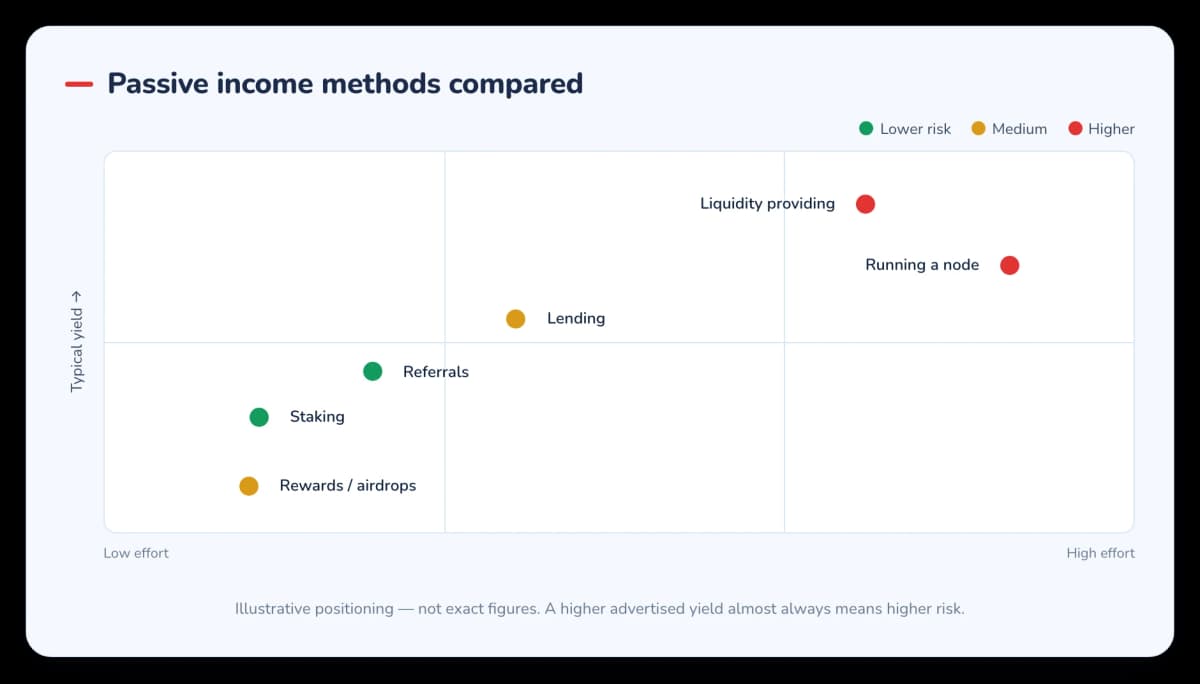
Here is how the six methods compare at a glance:
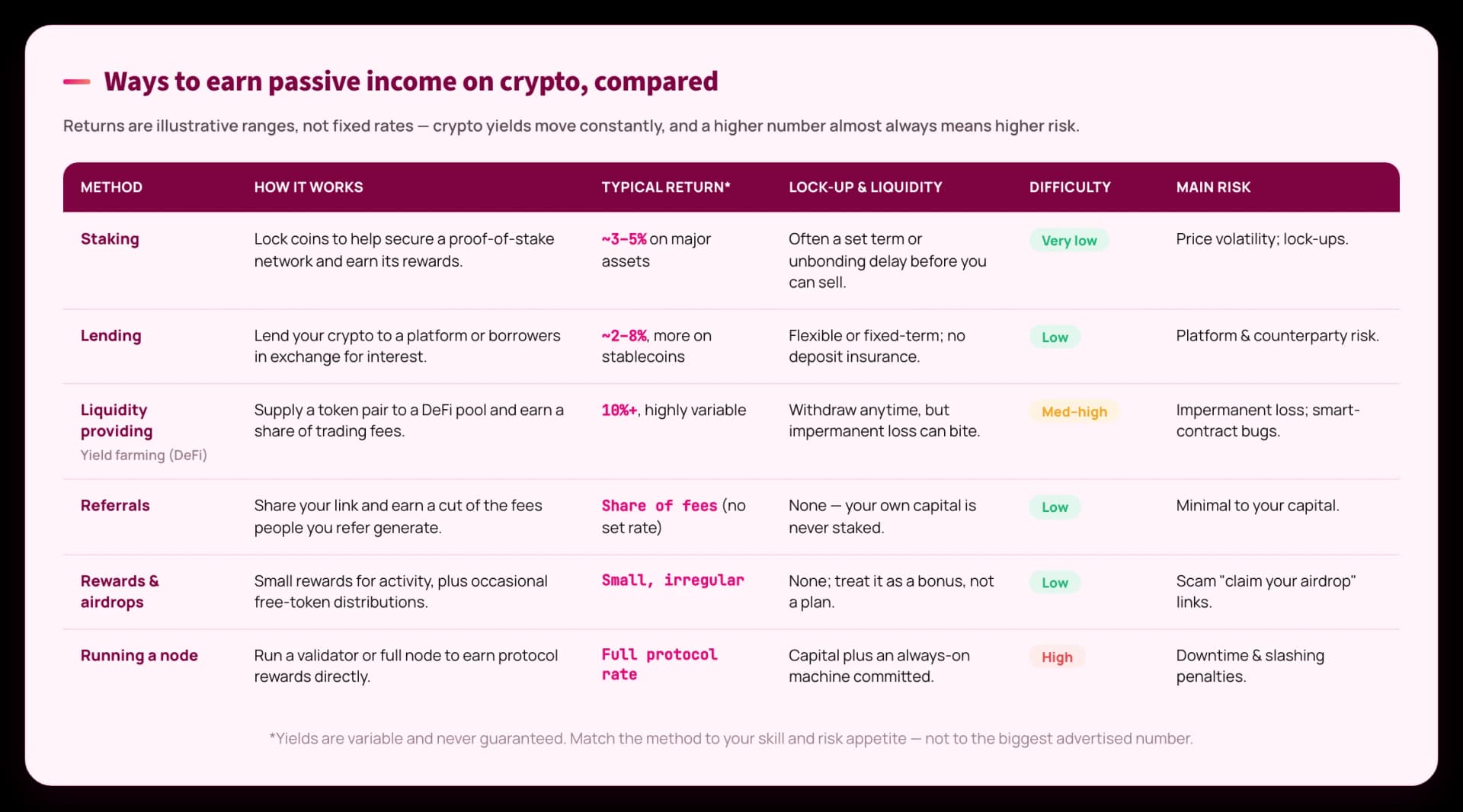
| Method | Typical yield | Effort | Main risk |
|---|---|---|---|
| Staking | 3–5% (major assets) | Very low | Volatility, lock-ups |
| Lending | 2–8% | Low | Platform / counterparty |
| Liquidity providing | 10%+ (variable) | Medium–high | Impermanent loss |
| Referrals | Share of fees | Low | Minimal to your capital |
| Rewards / airdrops | Small, irregular | Low | Scam links |
| Running a node | Full protocol rate | High | Downtime, slashing |
A simple way to think about it:
- Just starting out? Staking and referrals are the lowest-effort, lowest-risk entry points.
- Comfortable with more risk? Lending and liquidity pools can pay more, but read the fine print.
- Technical and hands-on? Running a node gives you the most control.
Whatever you choose, only commit funds you can afford to lock up and to see fall in value.
The risks nobody puts in the headline
Every passive-income method shares a few risks worth stating plainly:
- Price volatility. Your rewards and principal are in crypto and can fall sharply in dollar terms.
- No deposit insurance. Crypto holdings are not protected the way bank deposits are.
- Lock-ups. Some products tie up your coins for a set term, so you cannot always sell right away.
- Platform risk. With any custodial service, you rely on the platform's security and solvency.
- Taxes. In many countries, crypto rewards are taxable income when you receive them. Keep records.
How to start earning with Yimmit
Yimmit keeps it simple with two low-effort options — fixed staking and its built-in referral program:
- Create and verify your account, then deposit a supported asset.
- For fixed staking, Yimmit currently supports BTC, ETH, and USDT, with lock terms of 10, 30, or 365 days. The yield is shown in the app before you confirm — recently around 1% on USDT and 1–2% on BTC and ETH — and it can change over time.
- Track everything you earn in My Earnings.
- Share your referral link to earn USDT when the people you refer trade.
Yimmit is operated by Tradeview Financial Markets S.A.C. in Peru. As a Virtual Asset Service Provider (PSAV), it is designated an "obligated subject" under Supreme Decree No. 006-2023-JUS and is regulated by Peru's Financial Intelligence Unit (UIF-Perú) for anti-money-laundering and counter-terrorist-financing (AML/CFT) purposes. Treat all yields as variable and do your own research.
Related guides
Frequently asked questions
Can you really earn passive income with crypto? Yes, through methods like staking, lending, and referrals — but "passive" does not mean risk-free. The yield is payment for taking on risk, and your capital can still fall in value. Realistic, sustainable rates are usually modest.
What is the safest way to earn passive income in crypto? Lower-risk options include staking major assets and referral programs, where you are not exposing your own capital to a strategy. No method is fully safe, because the underlying coin can always fall in price.
How much can I earn? It depends on the method, the asset, and market conditions. Major-asset staking typically pays low single digits a year. Be skeptical of any platform promising large, "guaranteed" returns — that is a classic warning sign.
Is crypto passive income taxed? In many countries, yes — usually as income when you receive the rewards. Rules vary by location, so check your local guidance and keep clear records.
Do I need a lot of money to start? No. Staking through an exchange like Yimmit usually has a low minimum, and referral programs cost nothing to join. Start small while you learn how each method behaves.
Risk warning. Cryptocurrency is a volatile, high-risk asset. Yields are variable and not guaranteed, and funds may be subject to lock-up periods. Crypto holdings are not protected by deposit-insurance schemes. This article is for educational purposes only and is not financial or investment advice. Do your own research and only invest what you can afford to lose.
Sources and further reading
This article is educational and is not financial, investment, or tax advice. Crypto assets are volatile and carry risk; do your own research and consider a licensed professional before making decisions. About our editorial process.