English
 Español
 Português


Crypto Staking Explained: How to Earn Passive Income
Crypto staking lets you earn rewards on your cryptocurrency by helping run a blockchain. It works a bit like earning interest, but the rewards are paid in crypto. If you hold coins that support it, staking can turn idle holdings into passive income. This guide covers what staking is, how it works, how much you can earn, the risks, and how to start.
What is crypto staking?
Crypto staking is the process of locking up your cryptocurrency to help run a proof-of-stake blockchain, in exchange for rewards. You commit your coins, and the network pays you a yield — shown as an annual percentage yield (APY). Staking only works on proof-of-stake networks such as Ethereum, Solana, and Cardano.
Proof-of-stake replaced the old mining model. Instead of computers racing to solve puzzles, holders put coins up as collateral. Those staked coins keep the network honest. In return, stakers share the rewards the network pays out.
How does staking work?
A few simple roles make staking run:
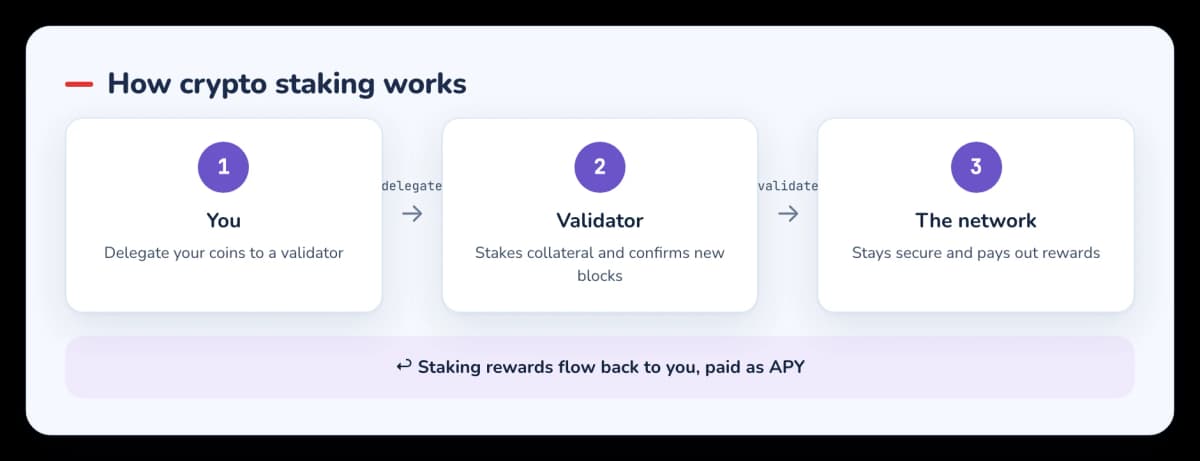
- Validators lock up coins as collateral and confirm new blocks of transactions.
- Rewards go to validators, and to the people who back them, for honest work.
- Slashing punishes validators who cheat or go offline. Part of their stake is taken.
- Delegation lets you stake through a validator without running your own computer.
Running your own validator is demanding. On Ethereum, it takes 32 ETH and an always-on node. Most people skip that. They delegate instead — staking through a validator or an exchange, and keeping their coins working with a few clicks.
Types of staking
Not all staking is the same. These are the main options:
- Native (delegated) staking. You delegate coins to a validator on the network itself. You keep ownership, and rewards come straight from the protocol.
- Exchange staking (or "earn"). A platform like Yimmit stakes on your behalf, or pays a fixed yield on coins you lock for a set term. It is simple, has low minimums, and needs no node. Note: some exchange "earn" products also pay a yield on assets that are not proof-of-stake, such as Bitcoin or stablecoins. That is lending-style yield, not true protocol staking, even though platforms often label both "staking."
- Liquid staking. You stake and get a token in return — for example, stETH for staked Ethereum through Lido. You earn rewards and can still use that token elsewhere.
- Fixed vs. flexible. Flexible staking lets you unstake anytime for a lower rate. Fixed staking locks coins for a set term in exchange for a higher, steadier yield.
How much can you earn?
It depends on two things: the network, and how you stake. Running your own validator (native staking) earns the protocol's full rate. As a rough, illustrative guide, native rates run about:
- Ethereum: about 3–5% a year
- Cardano: about 3–4%
- Solana: about 6–8%
- Polkadot: about 10–14%
- Cosmos: about 15–19%
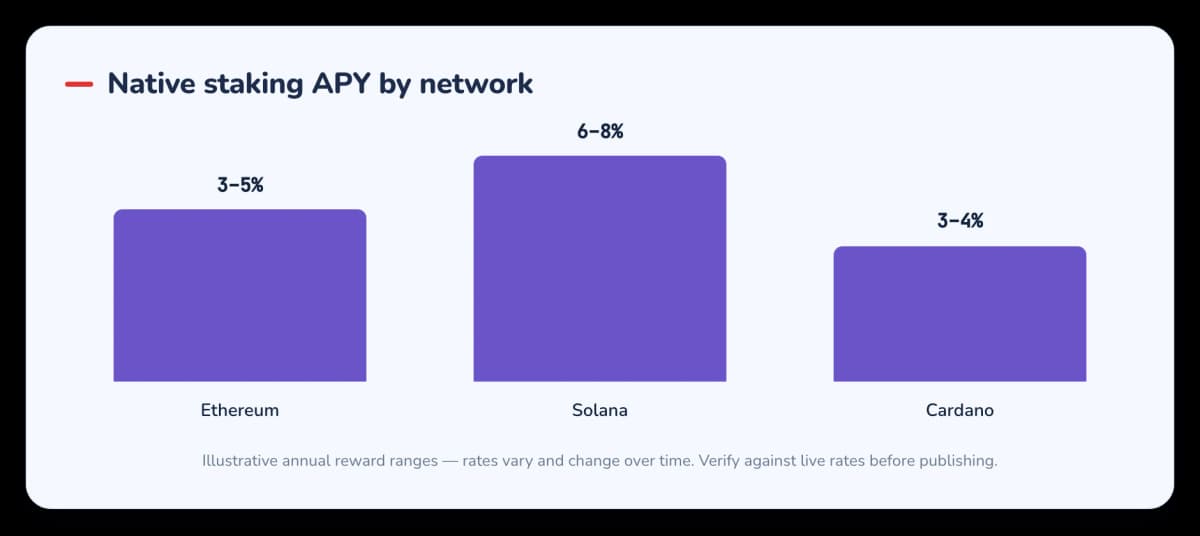
These figures are not fixed or guaranteed. One big driver is how much of a coin's supply is already staked. On Ethereum, roughly a quarter of all ETH is staked, which holds the base rate near 3–4%. Networks with less staked, like Cosmos, pay more to attract validators.
Staking through an exchange usually pays less. The platform runs the infrastructure and keeps a margin, so you get a set, more conservative rate rather than the raw protocol rate. On Yimmit, for example, fixed staking recently paid around 1% on USDT and 1–2% on BTC and ETH — below native rates, but with no node to run and a fixed term. Either way, the rate is shown before you commit and can change over time.
A quick example
Say you stake $1,000 of a coin at 5% APY. Over a year you earn about 50 dollars' worth of that coin, usually paid in small amounts you can compound. Here is the catch: your rewards and your principal are both in crypto. If the coin's price falls 20% that year, your stack is worth less in dollars even though you hold more coins. Staking grows your coin count. It does not protect the price.
Is crypto staking safe? Risks to know
Staking is lower-effort than trading, but it carries real risks:
- Price volatility. Your rewards and principal are in crypto, and the value can fall sharply.
- Lock-up and unbonding. Some networks make you wait to unstake. Cardano has no lock-up. Solana frees your coins in about two to three days. Cosmos takes 21 days and Polkadot takes 28. Ethereum uses an exit queue that can run from days to weeks when many people leave at once. You cannot always sell right away.
- Slashing. A badly run validator can lose part of its stake, so choosing a reliable one matters.
- Platform risk. With exchange staking, you rely on the platform. Pick a reputable, secure one.
- Taxes. In many countries, staking rewards count as taxable income when you receive them. Keep records.
Important: staking rewards are not guaranteed, and crypto is not covered by deposit insurance. A high APY never cancels out the risk of the coin losing value.
How to start staking with Yimmit
Yimmit offers fixed staking — you lock a supported asset for a set term and earn a yield, with no validator to run. Here is how to start:
- Create and verify your account, then deposit a supported asset. Yimmit's fixed staking currently supports BTC, ETH, and USDT.
- Choose your lock term — 10, 30, or 365 days.
- The rate is shown in the app before you confirm — recently around 1% on USDT and 1–2% on BTC and ETH — and it can change over time.
- Start the position, then track your rewards anytime in My Earnings.
Related guides
Frequently asked questions
Is crypto staking worth it? For long-term holders of proof-of-stake coins, it is a low-effort way to earn extra yield on coins you already plan to keep. Whether it pays off depends on the reward rate, the lock-up, and where the price goes.
Can you lose money staking crypto? Yes. Your coin count can grow while the dollar value falls. Slashing and lock-ups add risk. Staking cuts effort, not market risk.
What is the minimum amount to stake? It depends on the network and platform. Solo staking Ethereum needs 32 ETH. Staking through an exchange like Yimmit usually has a low minimum.
Can I unstake anytime? Sometimes. Flexible staking lets you exit quickly. Fixed staking, and some networks, impose a wait called an unbonding period.
Are staking rewards taxed? In many places, yes — usually as income when you receive them. Check your local rules and keep records.
How is staking different from a savings account? Both pay you to hold funds. But staking pays in crypto, the rates move, and there is no deposit insurance. The risk is very different from a bank.
Risk warning. Cryptocurrency is a volatile, high-risk asset. Staking rewards are variable and not guaranteed, and staked assets may be subject to lock-up periods and slashing. Crypto holdings are not protected by deposit-insurance schemes. This article is for educational purposes only and is not financial or investment advice. Do your own research and only invest what you can afford to lose.
Sources and further reading
This article is educational and is not financial, investment, or tax advice. Crypto assets are volatile and carry risk; do your own research and consider a licensed professional before making decisions. About our editorial process.