English
 Español
 Português


Crypto for Beginners: How to Get Started Safely

Crypto for beginners comes down to five steps: learn the basics, choose a reputable exchange, secure a wallet, start small with money you can afford to lose, and keep learning. Cryptocurrency is a high-risk, volatile asset with no guarantees — so the goal isn't to get rich fast, it's to get started safely.
If you're completely new, the world of digital currency can feel like a wall of jargon, hype, and horror stories. This guide is the calm starting point. It explains what these assets actually are, gives you a simple path to get started, walks through the handful of concepts every beginner needs, and — because your money is on the line — is honest about the risks, mistakes, and scams. Think of it as your home base: each section links out to a deeper guide when you're ready to go further.
What is crypto, in one paragraph
Cryptocurrency is digital money that runs on a decentralized network instead of a bank. Instead of a single company keeping the ledger of who owns what, tens of thousands of computers around the world keep a shared, public record called a blockchain, and cryptography keeps it secure and tamper-resistant. Bitcoin was the first, launched in January 2009 by the pseudonymous Satoshi Nakamoto and capped at 21 million coins that can ever exist. Today there are thousands more digital assets — Ethereum (launched 2015, the network behind most smart contracts, which switched to proof-of-stake in September 2022 and cut its energy use by about 99.9%), plus stablecoins such as USDT and USDC pegged 1:1 to the US dollar. Data sites such as CoinMarketCap track well over 10,000 of them, though Bitcoin alone still accounts for roughly 50% of the total market, which as of 2024 sat in the region of $2 trillion — up from about $17 billion in 2017 (a figure that moves constantly). No government or central bank controls most of these tokens, which is exactly why they can move freely across borders — and also why prices swing so hard and why there's often no safety net if something goes wrong. If you want the fuller story, start with what Bitcoin is and what cryptocurrencies are.
How to get started with crypto: a simple 5-step path
You don't need to understand everything before you begin. You need to begin safely. Here's the path almost every sensible newcomer follows.
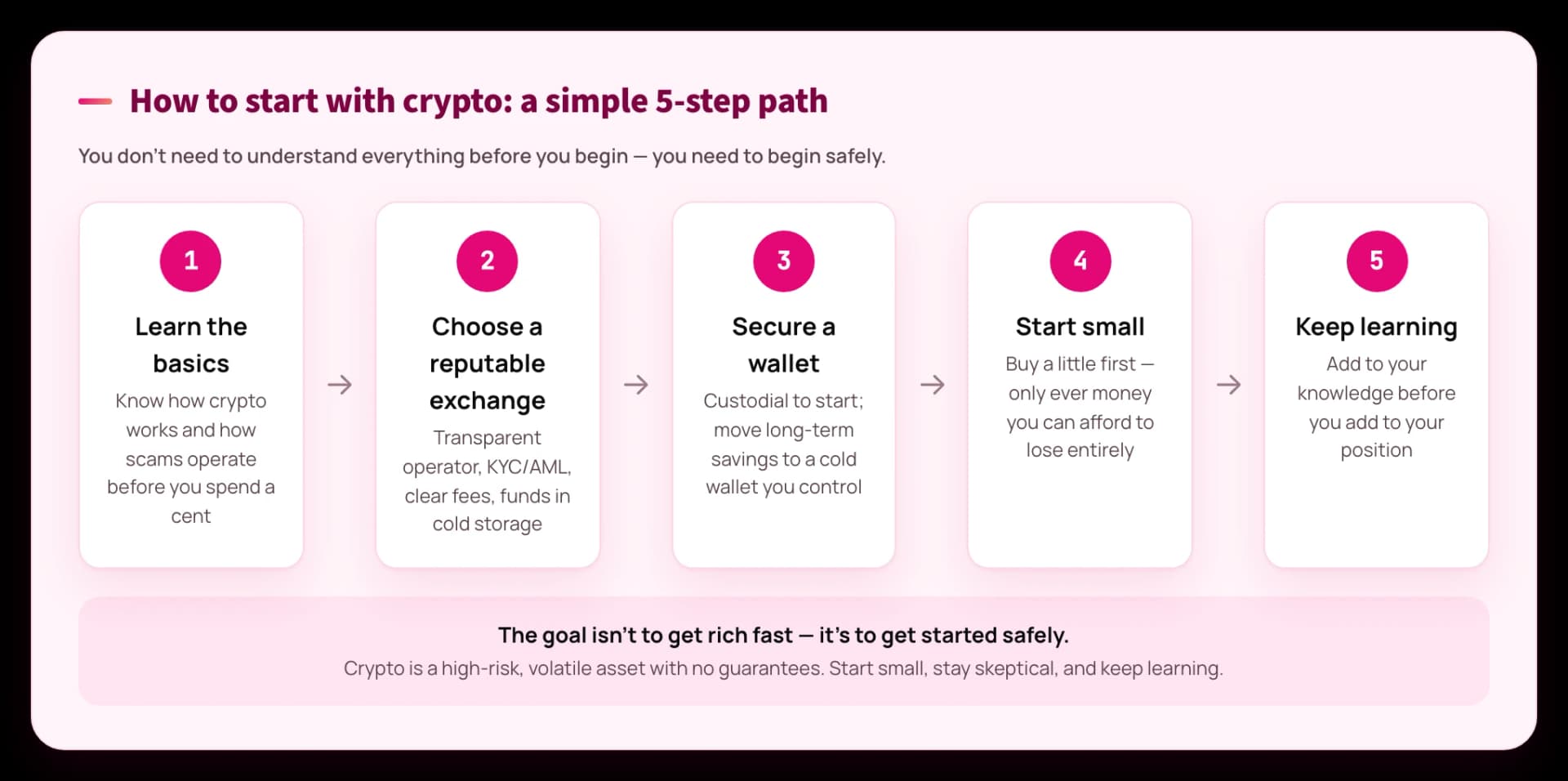
1. Learn the basics first
Before you spend a cent, understand what you're buying. You don't need a computer-science degree — just enough to know how the technology works, why it's volatile, and how the common scams operate. Reading this guide and the ones it links to is a solid start. The single most protective habit for any beginner is refusing to put money into anything you can't explain in a sentence.
2. Choose a reputable exchange
For most people, the easiest and safest first stop is a cryptocurrency exchange — a platform where you can buy, sell, and hold digital assets with ordinary money. Well-known examples include Coinbase, Kraken, and Binance, but not all exchanges are equal, so look for one that is transparent about who operates it, follows know-your-customer (KYC) and anti-money-laundering (AML) rules, has a clear fee schedule (often 0.1%–1.5% per trade), and keeps the bulk of customer funds in offline cold storage. Verification usually takes 5–10 minutes and requires a government ID. Avoid platforms that promise guaranteed returns or pressure you to deposit fast — those are red flags, not features. Our guide on how to start trading cryptocurrencies covers what to weigh when you pick a platform.
3. Secure a wallet
A wallet is what holds the keys to your coins. On a reputable exchange, the platform holds those keys for you (a custodial wallet), which is the simplest option when you're starting out. As your holdings grow, many people move longer-term savings to a cold wallet they control themselves — a device such as a Ledger or Trezor kept offline, out of hackers' reach. The trade-offs are worth understanding early, so read our guide to cold wallets vs hot wallets before you hold a serious amount.
4. Start small — with money you can afford to lose
This is the rule that saves beginners the most pain. Many exchanges let you start with as little as $1–$10 and buy a fraction of a coin (Bitcoin divides into 100 million units called satoshis), so buy a small amount first, get comfortable with how deposits, purchases, and withdrawals work, and only ever commit money whose total loss wouldn't hurt your finances. The UK's Financial Conduct Authority puts it bluntly: "If you decide to invest in crypto then you should be prepared to lose all your money."1 Treat that as your baseline assumption, not a worst case.
5. Keep learning
This market moves fast — it trades 24/7, 365 days a year, unlike stock exchanges — and the biggest losses usually come from acting on hype before understanding it. Keep reading, follow reputable sources, be skeptical of anything that sounds too good to be true, and add to your knowledge before you add to your position. Getting started is a beginning, not a finish line.
Key concepts every beginner should know
You only need to grasp a few ideas to be dangerous-free rather than dangerous. Here are the essentials.
- Blockchain. The shared public ledger that records every transaction. It's what lets a decentralized network agree on who owns what without a bank in the middle. Bitcoin adds a new block roughly every 10 minutes; Ethereum settles in about 12 seconds. Transactions, once confirmed, generally can't be reversed — there's no "undo" and no chargeback.
- Wallets. Software or hardware that stores your keys and lets you send and receive crypto. Wallets come in two flavors: hot (online, convenient) and cold (offline, safer for savings).
- Keys and your seed phrase. Your private key — usually represented by a 12- or 24-word seed phrase drawn from a fixed list of 2,048 words (the BIP-39 standard) — is what proves the coins are yours. Whoever holds it controls the funds. Never share it with anyone; no legitimate exchange or support agent will ever ask for it. Roughly 3–4 million of the 21 million bitcoins are estimated to be lost forever to forgotten keys.
- Volatility. Token prices can rise or fall 10%–20% in a single day. Bitcoin, for example, ran from under $1 in 2011 to about $1,000 in 2013, roughly $19,000 in 2017, then $69,000 in November 2021, before falling under $16,000 in 2022 — a peak-to-trough drop of about 76% (figures illustrative; check live prices). That volatility is the source of both the excitement and the risk, and it's why you should never invest money you might need soon.
- Gas fees. Every transaction on a network like Ethereum carries a small processing fee, paid in the network's native coin (ETH). Fees rise when the network is busy, so a $5 transfer can sometimes cost more than you'd expect. Bitcoin's supply is also disinflationary: its mining reward halves every 4 years (last in April 2024, to 3.125 BTC), and the final coin is projected to be mined around 2140.
Understanding these ideas puts you ahead of most people who "ape in" on a tip. When you're ready to go deeper on the underlying tech, read what cryptocurrencies are.
Common beginner mistakes and scams to avoid
Scams follow the money, and crypto has plenty of it.
Most of those losses were avoidable. Here's what to watch for.
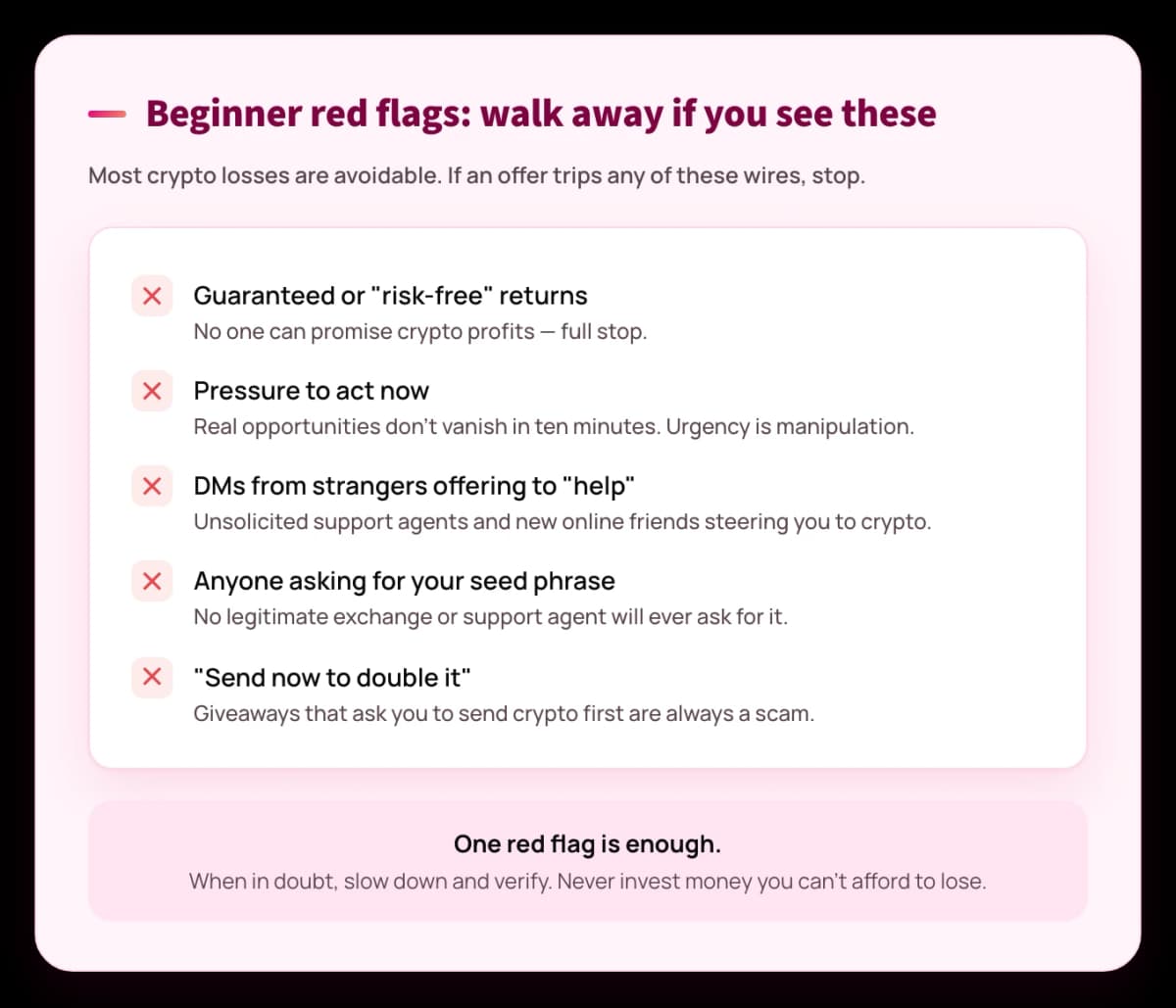
- "Guaranteed returns" and giveaways. No one can guarantee crypto profits. Any promise of fixed, high, risk-free returns — or a giveaway that asks you to send crypto first — is a scam. Full stop.
- Pressure to act fast. Legitimate opportunities don't evaporate in the next ten minutes. Urgency is a manipulation tactic.
- Anyone asking for your seed phrase or remote access. Support staff, "account verifiers," and love interests who need your recovery phrase are all impersonators. Sharing it hands over your funds.
- Fake apps and phishing sites that mimic a real exchange or wallet to capture your login or seed phrase. Always check the URL and download apps only from official sources.
- "Recovery" services that promise to get scammed funds back for an upfront fee — usually a second scam targeting victims of the first.
Beyond scams, the most common self-inflicted mistakes are investing more than you can afford to lose, chasing a coin because it's pumping, skipping the research, and losing access by misplacing a seed phrase or storing it in a screenshot. For the full playbook, see our guide on how to avoid crypto scams.
Is crypto safe for beginners? Setting realistic expectations
Crypto can be used safely, but it is not a safe investment — those are different things. Being realistic from day one is what separates people who have a good experience from those who get burned.
- It's high risk and volatile. Prices can fall as fast as they rise. A holding can lose 50%–90% of its value in weeks, and some coins go to zero — an estimated 24,000+ tokens have already been abandoned or delisted since 2014.
- There are no guarantees and no safety net. Unlike a bank deposit, most crypto isn't covered by government insurance or compensation schemes. If a platform fails or you're scammed, recovering your money is often impossible.
- It's largely unregulated. In many countries crypto sits outside the protections that apply to regulated investments, which is why choosing a transparent, compliant platform matters so much.
- You are responsible. The flip side of "be your own bank" is that mistakes are yours to own. There's rarely anyone to appeal to.
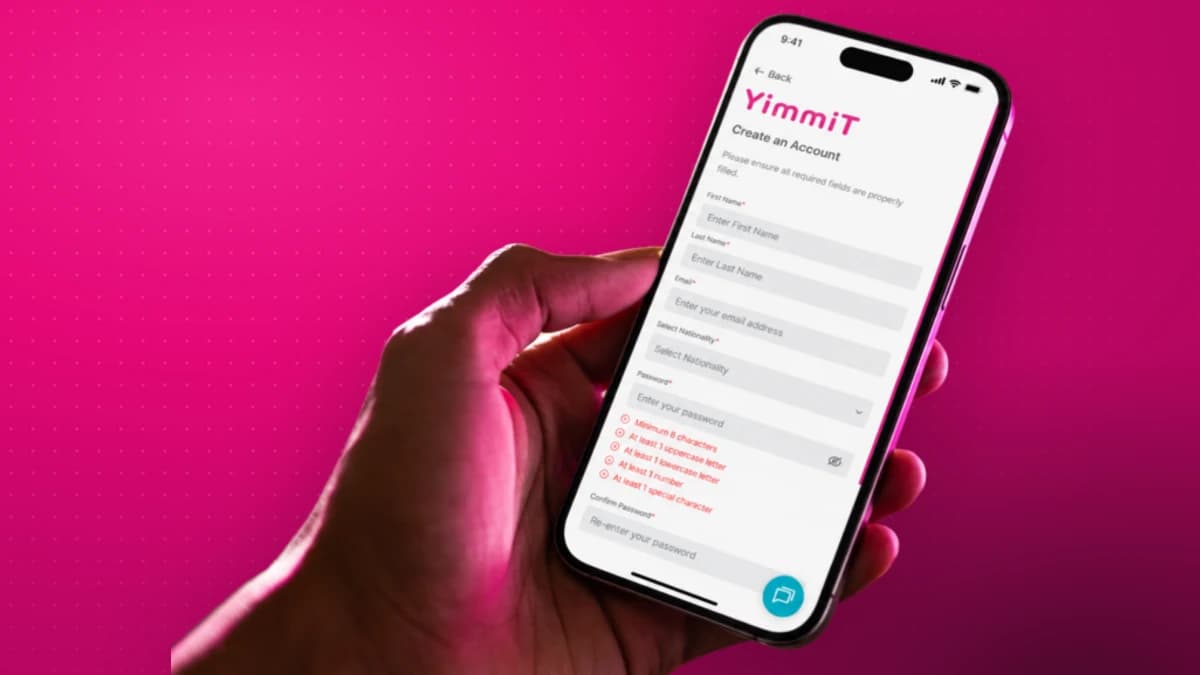
Getting started with Yimmit
Related guides
- What is Bitcoin? A simple explanation
- What are cryptocurrencies?
- Cold wallet vs hot wallet: how to store crypto safely
- How to avoid crypto scams
- How to start trading cryptocurrencies
Frequently asked questions
How do I get started with crypto as a complete beginner? Follow a simple path: learn the basics, choose a reputable exchange, secure a wallet, and buy a small amount with money you can afford to lose — then keep learning before you add more. Starting small while you get comfortable is the safest way in.
How much money do I need to start with crypto? Very little. Most exchanges let you buy a small fraction of a coin, so you can start with a modest amount — even the equivalent of a few dollars. The right amount for a beginner is small enough that losing all of it wouldn't affect your finances.
How do I buy my first crypto? Sign up with a reputable exchange, complete its identity verification (KYC), deposit funds, and place a buy order for the crypto you want. Start with a small purchase so you can learn how deposits, buying, and withdrawals work before committing more.
Is crypto safe for beginners? Crypto can be used safely, but it is not a safe investment. It's volatile, largely unregulated, and rarely protected by any safety net, so you should only invest money you can afford to lose entirely. Using a reputable platform and guarding your seed phrase reduces avoidable risk.
What is the most common beginner mistake in crypto? Investing more than you can afford to lose — often by chasing a coin that's rising fast without understanding it. Close behind are falling for "guaranteed return" scams, skipping research, and losing access by mishandling a seed phrase.
Do I need a wallet to start? Not separately at first. When you buy on a custodial exchange, the platform holds the keys for you, so there's no seed phrase to manage. As your holdings grow, many people move long-term savings to their own cold wallet for extra security.
Risk warning. Cryptocurrency is a volatile, high-risk asset and its value can fall sharply, including to zero. Crypto is largely unregulated and generally not protected by deposit-insurance or investor-compensation schemes; lost keys or a lost seed phrase cannot be recovered. This article is for educational purposes only and is not financial, investment, or tax advice. Do your own research and only invest what you can afford to lose.
Sources
- UK Financial Conduct Authority, "Investing in crypto" (InvestSmart). "If you decide to invest in crypto then you should be prepared to lose all your money." https://www.fca.org.uk/investsmart/investing-crypto ↩
- U.S. Federal Trade Commission, "Reported crypto scam losses since 2021 top $1 billion, says FTC Data Spotlight" (June 2022). More than 46,000 people reported losing over $1 billion in crypto to scams since the start of 2021; median individual reported loss $2,600. https://www.ftc.gov/business-guidance/blog/2022/06/reported-crypto-scam-losses-2021-top-1-billion-says-ftc-data-spotlight ↩
This article is educational and is not financial, investment, or tax advice. Crypto assets are volatile and carry risk; do your own research and consider a licensed professional before making decisions. About our editorial process.