English
 Español
 Português


What Are Stablecoins? USDT, USDC and How They Work
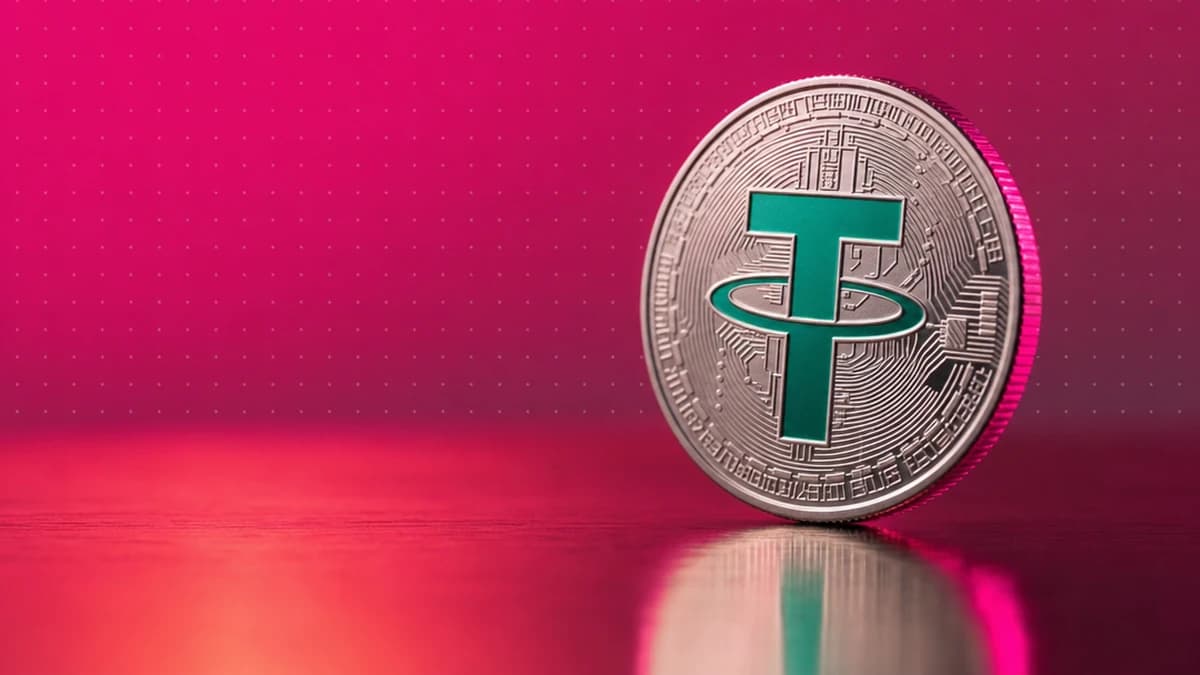
Stablecoins are the part of crypto that does not swing wildly. While Bitcoin can move 10% in a day, a dollar-pegged token is built to sit still at about one US dollar. That single idea — a digital dollar that lives on a blockchain — is why the roughly $250 billion of stablecoins in circulation (as of late 2025; figures shift) now move trillions of dollars a year and quietly power most crypto trading — by some estimates over $27 trillion in transfers in 2024, rivaling the volume of major card networks. More than 99% of that value is tied to the US dollar rather than any other currency. This guide explains what stablecoins are, how they hold their value, the main types, whether they are safe, and how USDT and USDC differ.
What are stablecoins?
A stablecoin is a cryptocurrency designed to hold a steady value by being pegged to a stable asset — usually the US dollar, so one coin is meant to always equal about $1. The two largest are USDT (Tether), launched in 2014 and worth more than $140 billion, and USDC (Circle), launched in 2018 at roughly $60 billion (late 2025; both values move daily). Both are backed by reserves of dollars and dollar-equivalent assets held by their issuers. Together they dominate a market of more than 200 different tokens — USDT alone accounts for roughly 60% of all stablecoin supply, and USDC for most of the rest.
Ordinary cryptocurrencies like Bitcoin float freely — their price is whatever the market will pay, minute to minute. A dollar token does the opposite. It targets a fixed price and uses reserves or rules to defend it. That makes it useful as digital cash: a way to hold value, send money, and trade, all on a blockchain, without the volatility.
Why do stablecoins exist?
These coins solve a practical problem. Crypto markets run 24/7, but the traditional banking system does not. If you sell Bitcoin at 2 a.m. on a Sunday, you cannot instantly move the proceeds to a bank. Dollar tokens give traders a place to park value that stays put and settles in minutes, any time.
Beyond trading, they exist because a lot of people want US dollars they can actually access. In countries with high inflation or strict currency controls, buying physical dollars can be hard or expensive. A dollar-pegged coin on a phone is often the closest thing available. That demand — especially across Latin America — is a big reason these coins have grown so fast.
How does a stablecoin work?
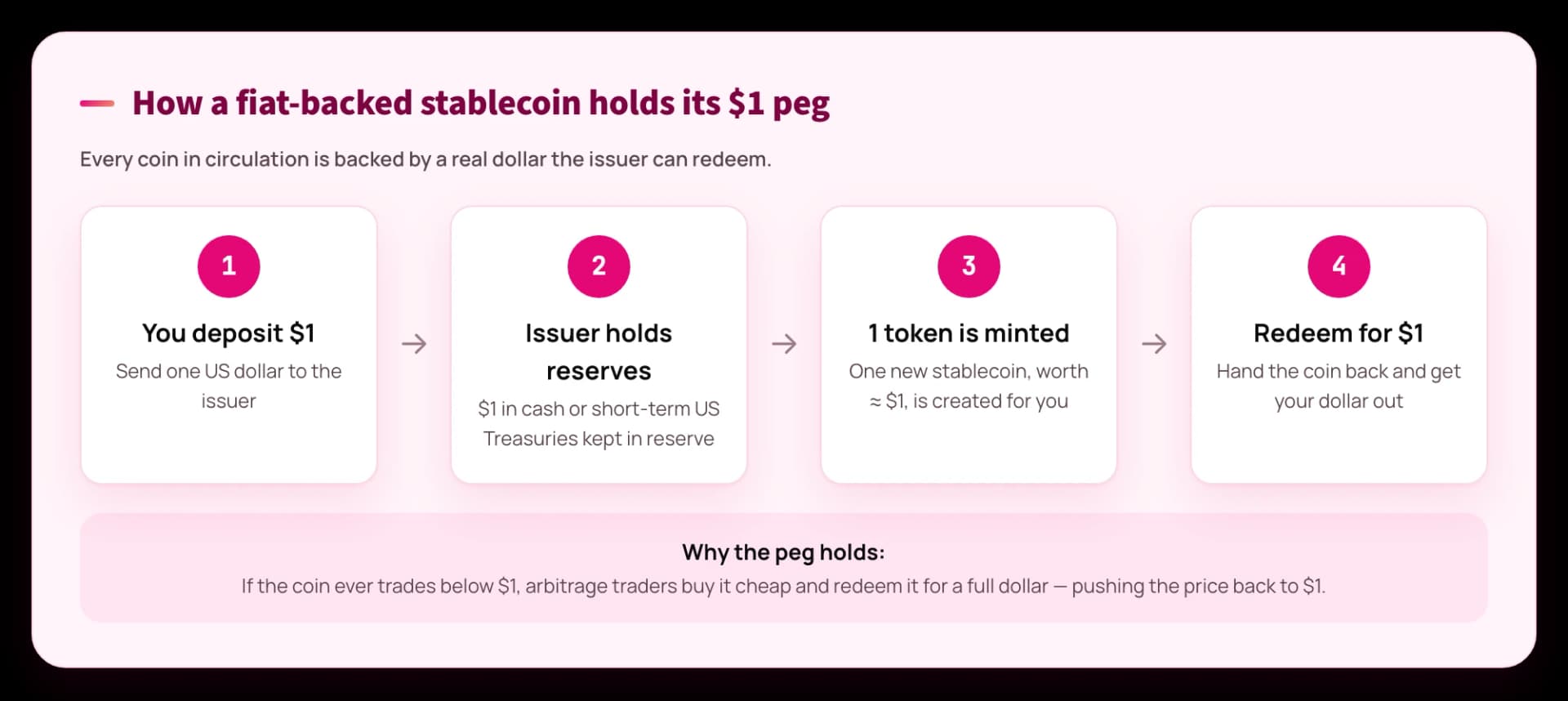
The mechanism depends on the type, but the most common design is simple. For every coin in circulation, the issuer holds one dollar (or a dollar's worth of safe assets) in reserve. You can, in principle, always redeem one coin for one dollar. That promise is what keeps the market price near $1: if the coin trades below a dollar, arbitrage traders buy it cheap and redeem it for full value, pushing the price back up.
Types of stablecoins
There are three main types of stablecoins, and they are not equally safe.
- Fiat-backed (collateralized by cash). Each coin is backed by real dollars and short-term assets like United States Treasury bills held in reserve. Tether reported holding over $100 billion in United States Treasuries in 2025 — more than the reserves of many national governments — and the interest on those holdings made it one of crypto's most profitable firms, with a reported net profit near $13 billion in 2024. This is the largest and most trusted category, worth well over $200 billion combined. USDT and USDC are both fiat-backed. The main risk is trusting that the issuer truly holds the reserves it claims.
- Crypto-backed. The coin is backed by other cryptocurrencies locked in a smart contract. Because crypto is volatile, these are usually over-collateralized — you might lock $150 of Ether to mint $100 of the token, a collateral ratio around 150% that leaves a buffer if prices drop. DAI, launched by MakerDAO in 2017, is the best-known example. No bank is involved, but the collateral itself can swing.
- Algorithmic. These hold their peg not with reserves but with code and a linked "sister" token that the system mints and burns to balance supply and demand. They are the riskiest kind by far. When confidence goes, the algorithm can spiral instead of self-correcting.
That last category is not theoretical. In May 2022, the algorithmic stablecoin TerraUSD (UST) lost its dollar peg and collapsed within days, taking its sister token LUNA — which crashed from over $80 to a fraction of a cent — and roughly $40 billion in value down with it. UST was backed by LUNA rather than by cash reserves, and once holders lost faith, a "death spiral" flooded the market with LUNA and the peg could not be defended. A Federal Reserve Bank of Richmond post-mortem summed up the lesson bluntly: keeping a currency stable "is the part of economics [that] cannot be replaced by technology." The takeaway for everyday users is straightforward — treat algorithmic stablecoins with deep caution, and understand what actually backs any coin before you hold it.
USDT vs USDC
USDT and USDC are both fiat-backed dollar stablecoins, and in day-to-day use they behave almost identically. The differences are about issuer, transparency, and reach.
| USDT (Tether) | USDC (Circle) | |
|---|---|---|
| Issuer | Tether | Circle (United States) |
| Backing | Cash & cash-equivalents (mostly United States Treasuries) | Cash & short-dated United States Treasuries |
| Size | Largest — market value above $140B (late 2025) | Second largest — roughly $60B |
| Transparency | Publishes reserve reports; historically criticized for less detail | Publishes regular attestations; generally seen as more transparent |
| Strength | Deepest liquidity, widely accepted, dominant in emerging markets | Favored where regulatory clarity matters |
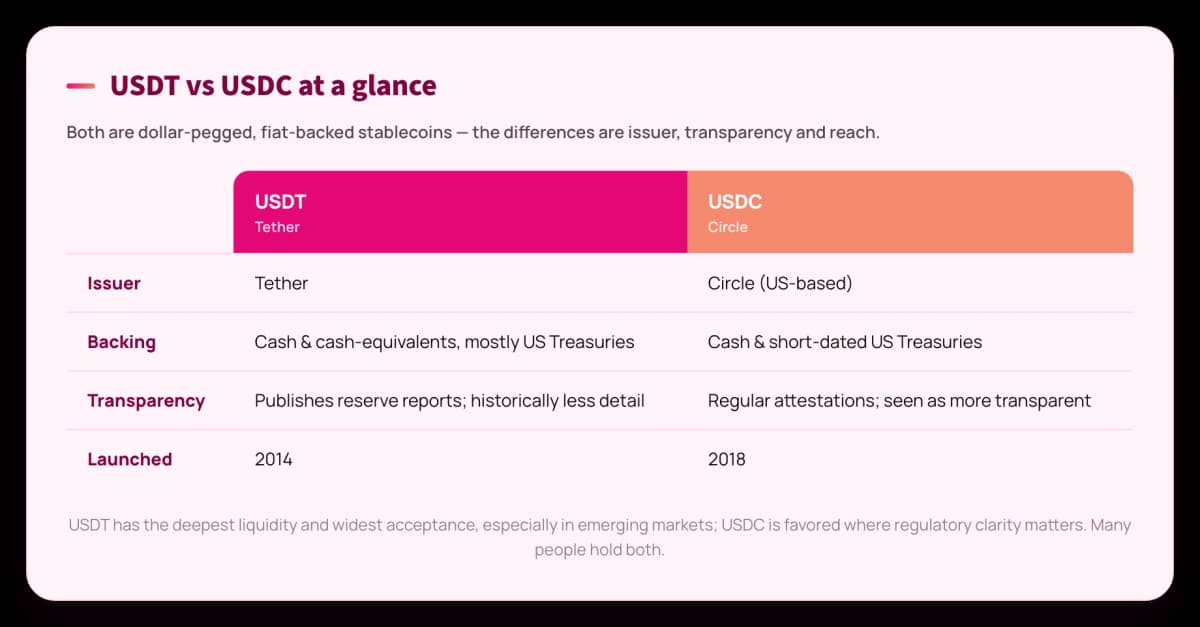
So which is better? Neither is strictly "safer" for a typical user. USDT has the most liquidity and the widest acceptance, especially across Latin America, Asia, and other emerging markets — if you want the coin that is accepted almost everywhere, it is usually Tether. USDC is often preferred by users and businesses that prioritize a US-regulated issuer and detailed reserve reporting; Circle listed on the New York Stock Exchange in 2025, adding public-company disclosure on top. Many people hold both. What matters more than the choice between them is that you understand each is only as reliable as the reserves behind it.
What are stablecoins used for?
Dollar tokens are not just for traders. Real, everyday uses include:
- Trading crypto. Stablecoins are the base currency of crypto markets. Instead of cashing out to a bank, traders move between coins and a stablecoin — the BTC/USDT pair is consistently the single most-traded market in crypto. It is the "cash" side of most trades.
- Saving in dollars. In countries with high inflation or a weak local currency, people hold stablecoins to preserve purchasing power. It is a way to keep savings in dollars without a United States bank account — a major driver of adoption across Argentina, Venezuela, and much of Latin America.
- Remittances and payments. Sending a stablecoin across borders can settle in minutes for a network fee of cents to a few dollars, versus days and steep charges through traditional money transfer. For families sending money home, that difference is real money saved.
- On- and off-ramp. Dollar tokens are the bridge between regular money and crypto. You convert local currency to a stablecoin, then use it to buy other assets — and reverse the process to cash out.
- Earning a yield. In DeFi lending protocols such as Aave or Compound, holders can lend out coins for a return. These rates are variable, not guaranteed — historically anywhere from about 2% to over 10% depending on demand — and they carry smart-contract and platform risk on top of the usual depeg risk.
Because they are dollar-denominated and liquid, these coins are often the first crypto a new user in the region actually holds — before Bitcoin, before anything else.
Are stablecoins safe? Risks to know
These coins are far less volatile than Bitcoin, but "stable" does not mean "risk-free." The honest risks:
- Depeg risk. A stablecoin can lose its peg if reserves fall short, redemptions overwhelm the issuer, or an algorithmic design fails. Even large fiat-backed coins have briefly slipped below $1 during market stress — USDC fell to about $0.87 in March 2023 when $3.3 billion of Circle's reserves were briefly trapped at the failing Silicon Valley Bank, then recovered within days once access was restored.
- Issuer and reserve risk. With fiat-backed coins, you are trusting a company to genuinely hold the reserves it claims and to let you redeem. Reserve quality and transparency matter.
- No deposit insurance. These coins are not bank deposits. They are not covered by deposit-insurance schemes like the FDIC's $250,000 guarantee, so there is no government backstop if the issuer fails.
- Platform and custody risk. If you hold stablecoins on an exchange, you also rely on that platform's security. For larger amounts, many people move assets to a cold wallet they control.
- Regulatory scrutiny. Regulators worldwide are still deciding how to treat these assets. In the US, the GENIUS Act of 2025 created the first federal framework for dollar stablecoins, while the European Union's MiCA rules have applied since 2024.
The practical rule: stablecoins are a useful tool, not a guaranteed dollar. Know what backs the coin you hold, and do not keep more on any single platform than you are comfortable with.
Stablecoin vs Bitcoin: what's the difference?
People new to crypto often confuse the two, but they exist for opposite reasons.
- Purpose. Bitcoin, created in 2009 by the pseudonymous Satoshi Nakamoto, is designed to be a scarce, independent asset — many hold it hoping it appreciates. A dollar token is designed to not move; its whole job is to stay at $1.
- Volatility. Bitcoin's price swings hard. A pegged coin aims to be flat.
- Backing. Bitcoin is backed by its network and the market's belief in it, with a supply capped at 21 million coins. A fiat-backed stablecoin is backed by reserves held off-chain.
- Use. You hold Bitcoin as an investment or long-term store of value; you use a stablecoin to trade, pay, save in dollars, and move money.
Both run on blockchain technology, and many people own both — Bitcoin for upside, a stablecoin for the steady, spendable part of their portfolio.
Getting started with stablecoins
Frequently asked questions
What is USDT? USDT, or Tether, launched in 2014 and is the largest stablecoin, with a market value above $140 billion (late 2025) — a cryptocurrency pegged to the US dollar and backed by cash and cash-equivalent reserves, including over $100 billion in US Treasuries, held by its issuer, Tether. It circulates on blockchains including Ethereum, Tron, and Solana, and one USDT is meant to always be worth about one dollar.
What is the difference between USDT and USDC? Both are dollar-pegged, fiat-backed stablecoins and behave almost the same day to day. USDT (Tether) is the largest and most widely accepted, especially in emerging markets. USDC (Circle) is based in the United States and generally seen as more transparent about its reserves.
Are stablecoins safe? They are much less volatile than Bitcoin, but not risk-free. Coins can lose their peg, issuers can fall short on reserves, and stablecoins are not covered by deposit insurance. Algorithmic stablecoins are the riskiest — one, TerraUSD, collapsed entirely in 2022.
Can a stablecoin lose its value? Yes. This is called a "depeg." Small, brief depegs happen during market stress even to major coins. Large depegs are rare for well-reserved, fiat-backed coins but have wiped out algorithmic ones completely.
Why do people use stablecoins instead of dollars? They settle in minutes any time of day, move across borders cheaply, and let people in countries with inflation or currency controls hold dollar value without a United States bank account. They are also the base currency for most crypto trading.
Is a stablecoin the same as Bitcoin? No. Bitcoin floats and is held as a store of value or investment. A stablecoin is engineered to stay at about $1 and is used for trading, payments, and saving in dollars.
Sources
- Bank for International Settlements, Annual Economic Report 2025, "The next-generation monetary and financial system" — stablecoins assessed against the tests of singleness, elasticity, and integrity. https://www.bis.org/publ/arpdf/ar2025e3.htm
- Russell Wong, "Why Stablecoins Fail: An Economist's Post-Mortem on Terra," Economic Brief No. 22-24, Federal Reserve Bank of Richmond (July 2022). https://www.richmondfed.org/publications/research/economic_brief/2022/eb_22-24
Risk warning. Cryptocurrency is a volatile, high-risk asset. Stablecoins aim to hold a fixed value but can lose their peg, and their stability depends on the issuer's reserves; they are not bank deposits and are not protected by deposit-insurance schemes. This article is for educational purposes only and is not financial or investment advice. Do your own research and only invest what you can afford to lose.
This article is educational and is not financial, investment, or tax advice. Crypto assets are volatile and carry risk; do your own research and consider a licensed professional before making decisions. About our editorial process.