English
 Español
 Português


Bitcoin halving explained: what it is, when it happens and what it changes
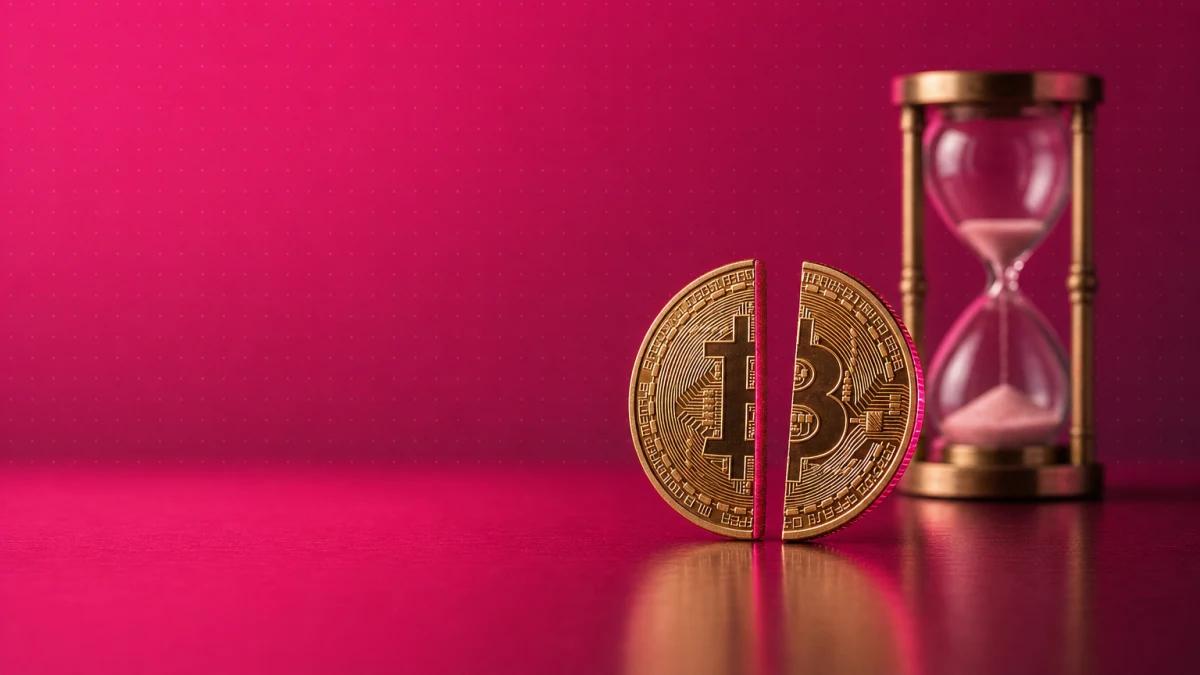
The Bitcoin halving is the moment when the number of new bitcoins that miners receive for each block is cut in half. It happens every 210,000 blocks, which is about every four years. The last halving, in April 2024, cut that reward from 6.25 to 3.125 BTC per block, and the next one, at block 1,050,000, is expected in 2028.
This guide explains how the halving works, lists every halving so far, shows when the next one is expected and why that date is only an estimate, and sets out what a halving does and does not change. New to Bitcoin? Start with our guide to what Bitcoin is.
What is the Bitcoin halving, and how does it work?
New bitcoins enter circulation through mining. The miner who adds a block to the blockchain collects the block reward, which has two parts: a block subsidy of newly created bitcoins and the fees paid by the transactions in that block.1 The Bitcoin whitepaper calls this the incentive: it rewards nodes for supporting the network and puts new coins into circulation, since there is no central authority to issue them.2
The halving cuts only the subsidy, and the rule is written into Bitcoin’s code. In Bitcoin Core, open-source software for running a Bitcoin node, the subsidy starts at 50 BTC per block and is “cut in half every 210,000 blocks which will occur approximately every 4 years.”3 No one has to decide or approve a halving: it happens automatically at the set block height. Miners also cannot pay themselves more than the rules allow, because every Bitcoin node would reject a block with invalid data.4
Every Bitcoin halving so far
When Bitcoin started in January 2009, each block paid 50 BTC in new coins.5 There have been four halvings since then, each exactly 210,000 blocks after the one before:
| Halving | Date (UTC) | Block height | New BTC per block |
|---|---|---|---|
| 1st | November 28, 2012 | 210,0006 | 50 → 25 |
| 2nd | July 9, 2016 | 420,0007 | 25 → 12.5 |
| 3rd | May 11, 2020 | 630,0008 | 12.5 → 6.25 |
| 4th | April 20, 2024 | 840,0009 | 6.25 → 3.125 |
| 5th (next) | Expected around April 2028 | 1,050,000 | 3.125 → 1.5625 |
The dates come from each block’s timestamp, in Coordinated Universal Time (UTC). In the Americas, it was still April 19 in local time when the 2024 halving happened.
When is the next Bitcoin halving?
The fifth halving will happen at block 1,050,000, when the subsidy falls from 3.125 to 1.5625 BTC.3 It is expected around April 2028. Block 976,000 was mined on November 15, 2026, which left exactly 74,000 blocks to go.10 At an average of 10 minutes per block, that is about 514 days, which points to mid-April 2028.
That date is an estimate, not an appointment, for three reasons:
- The halving follows block height, not the calendar. It happens when block 1,050,000 is mined, whatever the date is.
- Blocks arrive by chance. New blocks come about every 10 minutes on average, but finding one is probabilistic, so any block can arrive much sooner or much later.4
- The difficulty adjusts only every 2,016 blocks. The network compares how long those blocks took with the ideal of two weeks, then changes the mining difficulty to bring the average back toward 10 minutes.1
Past halvings show the effect. The same 210,000 blocks took 1,319 days from 2012 to 2016, 1,402 days from 2016 to 2020 and 1,440 days from 2020 to 2024. Any exact date stays an estimate until the last few weeks.
Why the supply stops just under 21 million
Because each halving cuts the subsidy in half, each 210,000-block era adds half as many new coins as the era before it: 10.5 million BTC in the first era, 5.25 million in the second, then 2.625 million, and so on.5 Adding halves of halves gets closer and closer to a limit without ever passing it. For Bitcoin, that limit is 21 million: issuance keeps halving until it stops at a total of 21 million.4
That is why most bitcoin already exists. By the 2024 halving, the schedule had released 19,687,500 BTC, or 93.75% of the 21 million.5 After the 2024 halving, new coins add about 0.8% a year to the supply; after the 2028 halving, about 0.4%.5
The last coins will take more than a century. The smallest unit of bitcoin is the satoshi: 1 BTC equals 100,000,000 satoshis.4 The subsidy keeps halving until it is smaller than one satoshi, so it falls to zero at block 6,930,000. If blocks keep arriving about every 10 minutes, that will be around the year 2140, and the schedule will have added up to 20,999,999.9769 BTC, just under 21 million.5
Subsidy plus fees: what miners earn
The halving touches only the subsidy. Fees, the other part of a miner’s pay, follow their own rules: users pay them, they depend on the size of each transaction, and they rise when many people compete for space in the next blocks.11
Fees can swing a lot. In the 2024 halving block, demand for block space was unusually high: fees reached about 37.6 BTC, roughly twelve times the new 3.125 BTC subsidy.9 In block 976,000, mined in November 2026, fees added only about 0.045 BTC.10
Each halving makes the subsidy smaller, so fees must cover a growing share of what miners earn. Bitcoin was designed for this: the whitepaper says that once a predetermined number of coins is in circulation, the incentive can move entirely to transaction fees.2
Whether fees alone will be enough is still an open question. A Princeton study found, in theory, that with fees as the only reward, the pay per block varies much more, and a miner can gain by replacing a recent block that holds high fees, which weakens security.12 For miners today, a halving also cuts their income from new coins in half from one block to the next, while their costs stay the same.
What a halving does not guarantee
A halving changes one thing for certain: how many new bitcoins each block creates. It does not set the price. As the U.S. Federal Trade Commission (FTC) puts it, the value of a cryptocurrency depends on many factors, including supply and demand, and it can change rapidly, even by the hour.13 The schedule is also public: new bitcoins are created at a decreasing and predictable rate, so the whole market knows about each halving years in advance.4
You will often see past halvings linked to later price rises. But there have been only four, each in a different market, with different demand, regulation and economic conditions. Four cases are far too few to make a rule, and past price moves around halvings do not predict future ones. The FTC also warns that an investment worth thousands of dollars today might be worth only hundreds tomorrow, and that if the value goes down, there is no guarantee it will go up again.13
Frequently asked questions
When is the next Bitcoin halving?
The next halving will happen at block 1,050,000 and is expected around April 2028. The exact day depends on how fast new blocks arrive, so estimates can shift as that block gets closer.
How often does the Bitcoin halving happen?
Every 210,000 blocks, which is roughly every four years. In practice, the gap between halvings has ranged from about three years and seven months to almost four years.
What will the block reward be after the 2028 halving?
The subsidy will fall from 3.125 BTC to 1.5625 BTC per block. Miners will still collect the fees of the transactions in each block on top of that.
What happens when all 21 million bitcoin have been mined?
The subsidy is expected to reach zero around the year 2140, with a total just under 21 million. From then on, the only pay for mining a block will be its transaction fees.
Does the halving make the Bitcoin price go up?
Not necessarily. The halving reduces how many new bitcoins are created, but the price depends on many factors, including demand. Past price moves around halvings do not predict future ones.
Can anyone change or stop the halving?
No single person, company or miner can. The halving is part of the rules that every Bitcoin node checks, and nodes reject any block that pays its miner more than those rules allow.
Related guides: crypto for beginners · how to start trading crypto
Risk warning. Crypto assets are volatile and carry risk. A halving changes how many new bitcoins are created, but it does not guarantee any price move, and past price moves around halvings do not predict future ones. This article is for educational purposes only and is not financial, investment or legal advice.
Sources
- Bitcoin Developer Guides, "Block Chain." https://developer.bitcoin.org/devguide/block_chain.html ↩
- Satoshi Nakamoto, "Bitcoin: A Peer-to-Peer Electronic Cash System" (the Bitcoin whitepaper), section 6, "Incentive." https://bitcoin.org/bitcoin.pdf ↩
- Bitcoin Core source code, release v32.1, src/validation.cpp, function GetBlockSubsidy. https://github.com/bitcoin/bitcoin/blob/v32.1/src/validation.cpp#L1833-L1844 ↩
- Bitcoin.org, "Frequently Asked Questions." https://bitcoin.org/en/faq ↩
- Bitcoin Wiki, "Controlled supply." https://en.bitcoin.it/wiki/Controlled_supply ↩
- mempool.space block explorer, "Block 210000." https://mempool.space/block/000000000000048b95347e83192f69cf0366076336c639f9b7228e9ba171342e ↩
- mempool.space block explorer, "Block 420000." https://mempool.space/block/000000000000000002cce816c0ab2c5c269cb081896b7dcb34b8422d6b74ffa1 ↩
- mempool.space block explorer, "Block 630000." https://mempool.space/block/000000000000000000024bead8df69990852c202db0e0097c1a12ea637d7e96d ↩
- mempool.space block explorer, "Block 840000." https://mempool.space/block/0000000000000000000320283a032748cef8227873ff4872689bf23f1cda83a5 ↩
- mempool.space block explorer, "Block 976000." https://mempool.space/block/00000000000000000000aeb828d7a8e9675a474c1be11d41e78c0d9d7dc1d8d2 ↩
- Bitcoin Developer Guides, "Transactions," section "Transaction Fees And Change." https://developer.bitcoin.org/devguide/transactions.html#transaction-fees-and-change ↩
- Carlsten, Kalodner, Weinberg and Narayanan (Princeton University), "On the Instability of Bitcoin Without the Block Reward" (extended version of their ACM CCS 2016 paper). https://www.cs.princeton.edu/~arvindn/publications/mining_CCS.pdf ↩
- U.S. Federal Trade Commission, Consumer Advice, "What To Know About Cryptocurrency and Scams." https://consumer.ftc.gov/articles/what-know-about-cryptocurrency-scams ↩
- YimmiT Docs, "Trading Pairs." https://docs.yimmit.com/trading/trading-pairs ↩
- YimmiT Docs, "Order Types." https://docs.yimmit.com/trading/order-types ↩
This article is educational and is not financial, investment, or tax advice. Crypto assets are volatile and carry risk; do your own research and consider a licensed professional before making decisions. About our editorial process.